
Adams Juvenile Release Access
Adams County Juvenile Detention Center operates at the Juvenile Justice Center in Natchez. The research found no official public list of young people currently held, recently released, or transferred from the center. That absence is intentional and important. Juvenile custody and court material is treated differently from adult booking information, and a public adult roster does not become a juvenile search merely because the county jail page mentions juvenile separation.
A lawful inquiry should go to the facility or the juvenile court channel connected to the case. Staff may first need to confirm the caller's identity, relationship, authority, and case information. They may decline to provide details to the public. A release can also involve a parent or guardian, another placement, a court-directed program, or another authorized destination, but the research does not establish a public list of local release categories. The official case participants must provide that information.
Confirm Adams Juvenile Release
The correct process starts with authorization rather than a name search. An authorized person should use known case and identity details to contact the Juvenile Justice Center. The facility can explain whether it may confirm status, what proof is required, and whether the question belongs with a court or another agency. This is not an adult released-inmate lookup.
- Gather the case number, court name, relevant dates, and the caller's proof of identity and lawful relationship.
- Call the Juvenile Justice Center main line and ask for the proper release or records contact.
- Follow the facility's current verification steps before asking for protected status or release details.
- Contact the court or counsel connected to the case when a court order or disposition is needed.
- Use only the information the authorized custodian is permitted to disclose.
Do not interpret silence, a declined answer, or the absence of an adult roster row as proof of release. Those results may simply reflect confidentiality. Likewise, a court date and a physical release time measure different events. The facility record addresses custody, while the court file contains the orders the court maintains and is permitted to disclose.
The general Adams County release search covers adult county, MDOC, VINE, federal, and ICE systems. It should be used for those adult systems only, not as a workaround for juvenile limits.
Note: A restricted response protects juvenile information and does not establish whether a specific young person is or was in custody.
Juvenile Center Contact Record
The official Adams County Juvenile Detention Center page is the source for the facility address and contact numbers. The center publishes a main number, director line, administrative-assistant line, office fax, and booking fax. These contacts help authorized parties route an inquiry, but they do not create a right to protected juvenile information.
Juvenile Justice Center
320 State Street
Natchez, MS
Main: 601-304-7886
Director: 601-304-7890
Administrative assistant: 601-304-7889
Office fax: 601-304-8055
Booking fax: 601-304-8075
The official facility source was captured successfully for the Adams juvenile contact record.
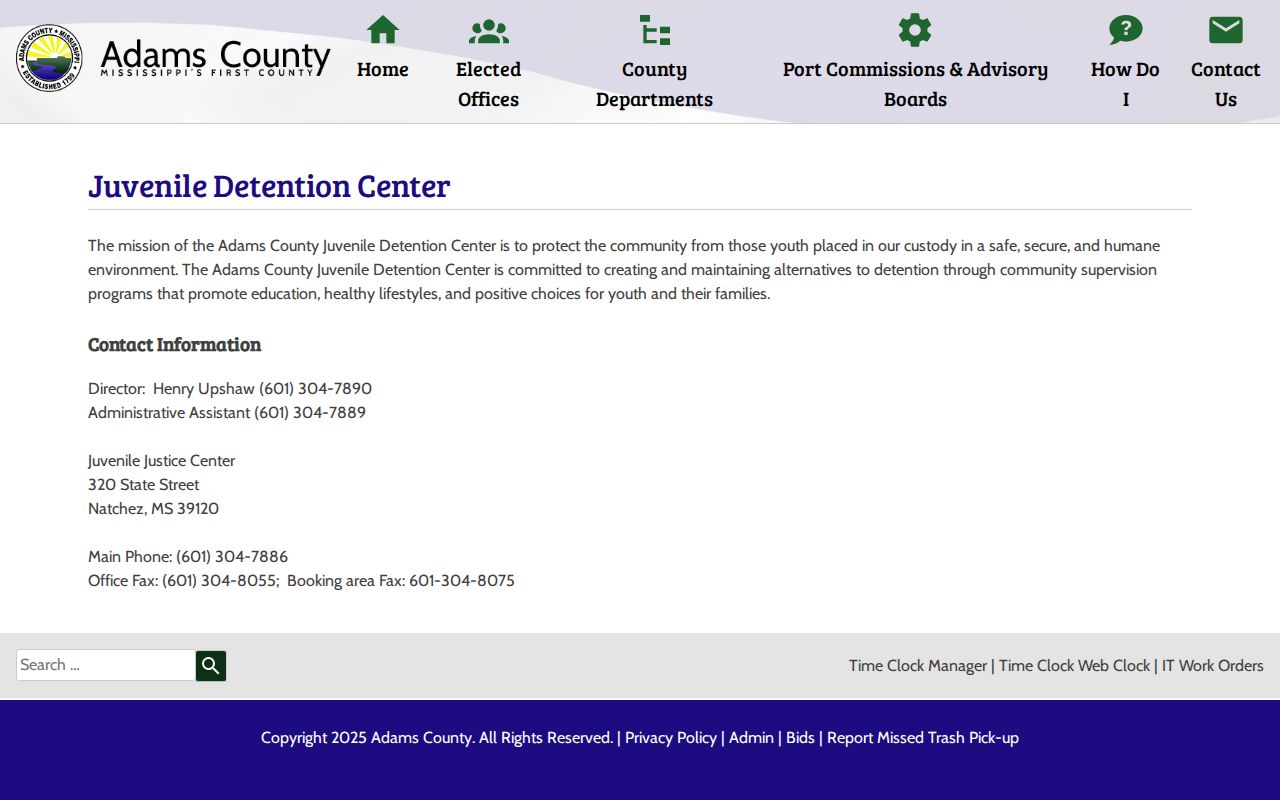
The image confirms the county's facility contact route, not a public juvenile search or a released-person list.
No public hours for release inquiries were confirmed. Call the main number before visiting or sending records. Do not send private juvenile facts through an unverified channel, and do not assume that a fax line accepts a public request without prior direction.
Adams Juvenile Record Boundaries
Mississippi's general public-record rules do not erase statutes, court rules, or orders that make material confidential. The research specifically identifies juvenile information among records that may be withheld or redacted. That is different from the adult Adams iSOMS feeds, where selected booking data and photos are affirmatively displayed. No public juvenile release feed, photograph archive, or open identity lookup was located.
| Source | Proper role | Public limit |
|---|---|---|
| Juvenile Justice Center | Facility contact and authorized custody questions | Identity and status may be restricted |
| Juvenile court channel | Orders and lawfully available case material | Access depends on authority and confidentiality rules |
| Adult iSOMS portal | Adult Adams County booking records | Not a juvenile release search |
| Public-record request | Request for disclosable existing records | Protected parts may be denied or redacted |
If a request is denied, ask for the applicable process and any written basis the custodian can provide. Do not seek names, photos, case facts, medical information, victim information, or placement details beyond what the law and the requesting person's authority permit. A narrow request is still subject to the same confidentiality rules.
Juvenile Release Versus Placement
Adult custody language can mislead in a juvenile matter. “Released” may mean the end of detention at this center, but it does not necessarily reveal the next court-directed arrangement. The young person could return to an authorized caregiver or move under another lawful placement or order. The available research does not document Adams County's full placement categories, so no unsupported list should be imposed on the facility.
- Release
- The authorized end of the specific detention episode, subject to the governing order.
- Placement
- A destination or arrangement directed through the juvenile process.
- Transfer
- Movement to another authorized custodian or facility rather than an unrestricted return.
- Disposition
- The court's resolution or order in the juvenile matter.
The distinction matters when dates appear in different sources. A signed order can precede facility processing. A receiving placement may record a later intake. Authorized counsel or the court can explain the legal order, while facility staff address what their own record shows and what can lawfully be disclosed.
Never use a missing public record as a claim that no case exists. Confidentiality, sealing, limited access, or an incorrect court channel can all produce no public result.
Requesting Adams Juvenile Records
An authorized records inquiry should name the exact record and explain the requester's lawful connection. Useful identifiers may include the case number, court, date range, and the type of document sought. Avoid broad requests for all juvenile files. The custodian may require identification, proof of guardianship, a signed authorization, counsel status, or a court order, depending on the record and requester.
The Mississippi Public Records Act allows an agency to separate exempt from nonexempt material and release what may lawfully be disclosed. It also preserves other confidentiality law. For juvenile material, the latter point can control much of the response. General public-record timing rules do not compel release of confidential records, and an agency may redact protected facts or deny the request with a legal basis.
A court record request should go to the court that maintains the case. Facility staff cannot rewrite a court order, and a public-record request is not an appeal of the juvenile court. If the question concerns compliance with an order or the rights of a child or guardian, consult the attorney or court contact already involved in the case rather than asking an adult jail portal to answer it.
Note: Specific case and authorization details help staff route a lawful request, but they do not make confidential juvenile material public.
Adams Juvenile Release Planning
Release logistics for a young person should be obtained directly through the authorized case team. The research did not locate a public release schedule, exit location, family waiting area, transport service, property rule, or published time-of-day practice for the Adams County Juvenile Detention Center. Rules from the adult jail or another county must not be borrowed.
An authorized caregiver can call ahead and ask what identification is required, where to report, whether a court document is needed, and how property or medication will be handled. Staff may provide instructions only after verifying the caller. If another agency or placement is involved, confirm which party controls transportation and when the handoff is complete.
The published contact list separates the main office, director, administrative assistant, office fax, and booking fax. That structure can help staff route an authorized question, but no public source assigns release requests to one of those lines. Begin with the main number unless an existing case contact gave different instructions. Verify a fax destination before sending any record because a booking fax and an administrative fax may serve different duties.
Safety and privacy should guide every step. Do not post a young person's anticipated release, location, photograph, or case facts. Use direct official communication. The fact that the center appears in the Adams County facility map is meant to route lawful contact, not to invite public tracking.